Tailor for
Available now · Portsmouth, UK

Engineering designer, materials scientist & educator.

I connect engineering design, product data and advanced materials — and I teach people how to use them. A PhD in nanoparticulate polymer coatings, 11 peer-reviewed papers, and four years implementing PTC Windchill PLM for 300+ UK engineering companies, from SMEs to GKN Aerospace and BAE Systems.

11Peer-reviewed scientific journal papers
300+Engineering companies enhanced, trained & supported with PLM, CAD, FEA
9University units taught, 2 as unit coordinator
1stClass BSc, MSc with Distinction, PhD completed on time
Collaborations
TriumphGKN AerospaceBAE SystemsToyotaGuritPall EuropeKCCSafeguard EuropeEcoDriftUniversity of PortsmouthCardiff UniversityUniversity of SouthamptonUniversity of BristolLoughborough UniversityUniversidad de Cádiz
About

Lab, lecture theatre and shop floor.

A career that has moved between research, teaching and industry — and is stronger for it.

I trained in Product Design and Modern Materials at the University of Portsmouth, then completed a bursary-funded MSc in Technology Management and a bursary-funded PhD on nanoparticulate polymer treatments that protect and insulate masonry. I finished the PhD on time, with eight journal papers published during the three-year programme (an unofficial record), and won two research conference awards.

I then joined the university as a Tutor (now called a Teaching Fellow) and, two years later, was promoted to Lecturer of Mechanical & Design Engineering in recognition of research I carried out in my own time. I taught and coordinated CAD/CAE and materials units, including distance-learning units that ran as late as 11pm for students in other time zones. I led industry testing and fault-analysis projects with partners including Toyota, Gurit and Pall Europe. I also supervised students from undergraduate to PhD. To get the most from every project, I aligned lecturer-defined student projects with planned journal papers, so students gained credit for real research and an edge in industry. Additionally, in summer ERASMUS foreign exchange students were also used to help contribute to publications.

After 11 years at Portsmouth, I wanted my teaching to rest on real industrial practice, so I left to gain it first-hand. I travelled first, learning to weld in all manual forms and earning a MIG welding ticket in New Zealand. Back in the UK, I became an Implementation Consultant for a PTC partner company; deploying and configuring PTC Windchill PLM, training engineers and, at times, project-managing rollouts. I delivered official PTC and customised training for companies such as Triumph, GKN Aerospace, BAE Systems and other ITAR-controlled MoD vendors. Training included Creo-based CAD/CAM and FEA training and on-site problem solving with client models often with limited turnaround time.

Consulting showed me many companies at different levels of maturity and what the state of the art looks like across UK engineering. From 2019 to 2026, as the only son in a small family with serious health issues, I stepped away from work to be a full-time carer for my father and mother. I kept learning throughout; Harvard online programmes in computer science and AI, freelance technology writing, and building robots and local AI tools at home. That chapter has now closed, and I'm ready for the next one.

Looking forPLM consultant, solutions or applications engineering roles
Also open toTeaching-focused academic posts in engineering or product design
Academic collaboratorsCardiff, Cádiz, Southampton, Bristol and Loughborough universities
Noteworthy2005 American Open Taekwondo champion (heavyweight). MIG-ticketed welder. Robot builder.
Expertise

What I bring.

In-depth knowledge and experience in materials and engineering design, with the rarer ability to explain it and add it into production systems.

PLM & digital engineering

Installing, upgrading, migrating and configuring PTC Windchill, from single servers to clustered multi-site deployments.

WindchillThingWorxSQL Server ↔ OracleITAR

CAD, FEA optimisation & product development

FEA design optimisation in Creo Simulate, which I have taught on-site to design engineers across many companies. Creo surface modelling, mould design, machining simulation, reverse engineering, top-down design, and additive manufacturing.

Creo SimulateFEA optimisationCreoFusionSolidWorks

Advanced materials & testing

Nanoparticulate smart polymer treatments, superhydrophobic thin films, and a full materials characterisation toolkit.

SEM/EDAXNanoindentationTGA/DSCRheometry

Teaching & technical training

FHEA-accredited lecturer and official PTC trainer. Unit coordination experience, distance learning, customised onboarding and documentation.

FHEADistance learningSupervision

AI, robotics & code

Python AI projects, plus C++ and C# experience. Local generative models, robot simulation, PCB design, and a pre-AI home-built robot arm.

PythonPyTorchIsaac LabReinforcement learningKiCad

Technical writing & delivery

Freelance writing on AI, coding and cybersecurity. Project reports, document templates, and project management for large rollouts.

ArticlesDocumentationMS Project
Selected work

Problems I've solved.

A few projects across industry, research and my own making — what the challenge was, what I did, and what came of it.

CreoOther CADDocuments ManufacturingSuppliersEngineers Windchill single source of truth CAD & data inControlled release out VersionsLifecycle statesWorkflows · ITAR
Industry2015–2019

Windchill PLM for aerospace & defence suppliers

Engineering teams needed one controlled source of truth for CAD parts, assemblies and documentation — in some cases under ITAR export controls.

  • RoleImplementation consultant, trainer and project manager
  • DidInstalled, upgraded and migrated Windchill (SQL Server ↔ Oracle, single-server to clustered multi-site); configured it to each client's processes; rebuilt templates and workflows for MoD vendors.
  • Result300+ companies supported, including Triumph, GKN Aerospace and BAE Systems.
FEA design optimisation · illustrative study
SimulationCreo SimulateSolidWorks SimulationFEA optimisation

Let the analysis design the part

Instead of checking one design at a time, optimisation tells the software what the part must do and lets it find the shape: the stiffest bracket for the weight, or the best paths to carry heat away.

  • TaughtCreo Simulate FEA design optimisation, on-site, to design engineers at many companies, as well as FEA training for BAE Systems engineers and FEA course material for Triumph.
  • ShownTwo classic studies solved from scratch with a finite-element optimiser: a cantilever bracket using 40% of the material (von Mises stress at the end), and a plate that grows conducting branches to a heat sink (temperature at the end).
  • WhyLighter, stiffer, cooler parts in fewer design loops, with structural and thermal performance designed in rather than checked afterwards.
  • AlsoEarlier studies in SolidWorks Simulation and Flow Simulation: static stress in a loaded I-beam, pressure and flow through a venturi pipe, and natural convection in a mug.
NVIDIA Isaac Lab · 256 robots learning in parallel
AI · RoboticsReinforcement learning2026

Teaching a robot to walk with reinforcement learning

Hundreds of copies of the robot practise at once on rough ground and stairs. Every attempt is scored, and the policy that keeps them walking is the one that survives.

  • DidTrained a walking policy for a quadruped of my own design in NVIDIA Isaac Lab, with 256 robots learning in parallel across a curriculum of rough and stepped terrain.
  • StackNVIDIA Isaac Sim 5.1 and Isaac Lab, Python, PyTorch, GPU-accelerated simulation on Linux.
  • WhySimulation-trained control is how today's legged robots learn to walk, and the same skills carry over to digital twins and automation in manufacturing.
Try itHeadset view
Loading the 3D work cell…

This demo needs a moment and an internet connection.

Industry 4.0AR / VR

AR work instructions for complex assemblies

People building engines or aircraft juggle thousands of parts. Augmented reality puts the next step, in exactly the right place, in front of them.

  • BuiltAn AR/VR app that anchored 3D-scanned objects to a printed marker, as a proof of concept for digitising the shop floor.
  • IdeaGive every part and subassembly a known position in a digital twin of the work cell, so headsets or tablets can guide each step and catch mistakes before they're built in.
  • Try itAssemble my MARS robot arm from its real CAD parts, picking the right one at each step; it runs a test move once built. Scroll or pinch to zoom, or double-click a part. For the AR view, switch on your camera and : lay it on your desk and the work cell snaps onto it.
Try itDrag the slider to add the nanoparticle treatment
Interactive illustration: as the nanoparticle coating increases, a water droplet on brick beads up, algae disappear and less heat escapes. RainAlgaeHeat
0%
Contact angle35°
Water uptakeHigh
Algae growthHigh
Heat lossHigh

Illustrative model. Measured results are in the papers below.

Research2009–2015

Nanoparticulate treatments that protect & insulate buildings

Could water-based silane/siloxane treatments loaded with TiO₂, ZnO and silver nanoparticles keep masonry dry, warmer and free of algae?

  • RolePhD researcher, then lecturer and lead author
  • DidFormulated emulsions; designed and built a model-house test rig, a wind tunnel for evaporating nanocolloids, and algae and dry-rot biofouling rigs.
  • Result11 journal papers in Energy and Buildings, Building and Environment, Construction and Building Materials and others.
EDAXsample electron gunbeam image builds line by line elementsCOSiTiZn
Scanning electron microscope + EDAX

A focused electron beam scans the surface to build a highly magnified image, while the X-rays it knocks out reveal which elements are present.

In my workUsed to see how nanoparticles sat in coatings and to look for the causes of failure in parts.

Consultancy2012–2015

Materials testing & fault analysis for industry

Manufacturers brought failing or new parts to the university for answers they couldn't get in-house.

  • RoleLead on testing, reverse engineering and fault analysis
  • DidAnalysed MWCNT fuel-cell membranes, smoke sensors, thin-film coatings and injection-moulded medical and automotive parts; helped secure, setup, and use a £100K magnetic-bearing rheometer for the University, complementing the APC research group's test equipment.
  • PartnersToyota, Gurit, Pall Europe, KCC, Safeguard Europe, EcoDrift.
DesignCAD / CAM

From concept render to production tooling

Product design is where materials, manufacturing and people meet. I design for the tool as well as for the user.

  • Did3D concept models and photoreal renders, and injection-mould tool design with core and cavity halves. Finished a client's mould tooling to a next-day deadline during PTC training.
  • TaughtCAD, CAE and product realisation units, from first sketches to manufacture.
Making2020–2026

Robots, from CAD to working hardware

Builds that bring mechanical design, electronics, code and AI together: designed, 3D-printed, wired and programmed at home.


  • ArmMARS Mk1, my own 6-axis robot arm (2020): designed in Fusion 360, 3D-printed, with stepper-driven joints and a self-wired control cabinet. Quick-change tools turn it from a gripper into a 3D printer, and a suction-cup “Foot” lets it be moved and re-used fast.
  • CodeC# control software with a live 3D simulator (WPF and Helix Toolkit), built on the open-source AR3 arm's firmware. Its website became my Harvard CS50x final project. A smaller arm tests inverse kinematics.
  • BalancerACRoBoT, a two-wheeled self-balancing robot: a green printed prototype, then a refined enclosure on a custom PCB.
  • SimA quadruped trained to walk in NVIDIA Isaac Lab: see robot learning above. Currently building.
AI-generated product mockup: a model wearing a printed black T-shirt
Product mockup
AI-generated lifestyle shot of a walnut cutting board with a resin cross inlay
Lifestyle scene
Motion transfer
AI2026

Local generative-AI tools for product mockups & video

Desktop apps that turn product images into realistic mockups and transfer motion between videos — running entirely on a home PC.

  • DidBuilt Python applications on PyTorch and Hugging Face Diffusers, chose commercially licensed models, and engineered them to fit within 16 GB of GPU memory.
  • ShowsPractical, AI-assisted software development with real constraints.
Inside the lab

Rigs I built, data I trusted.

Designing the experiment is half the science. Explore the wind tunnel and the biofouling tank I built, look down the microscope, then meet the kit behind the results.
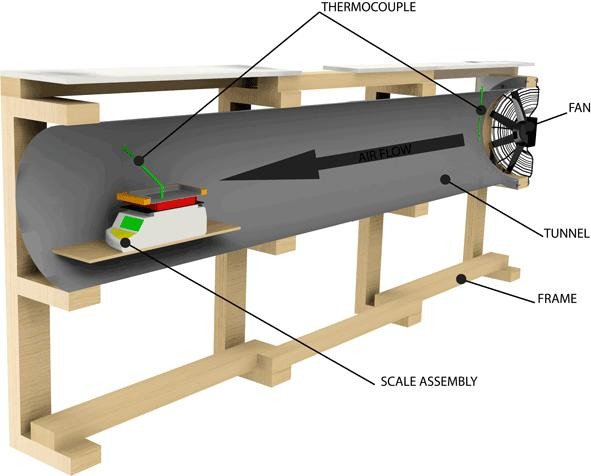
Labelled render of the evaporation wind tunnel: fan, tunnel, thermocouples, scale assembly and timber frame
Try it

Evaporation wind tunnel

Built for my research on nanoparticle coatings: it dries treated samples under steady, repeatable airflow while a balance logs how fast the water leaves.

Medium
sample masstime

Illustrative: faster air, faster drying. Tap the numbered points to see what each part does.

Tap a number

Each part of the rig had a job in making the measurements fair and repeatable.

Biofouling rig

Algae on demand

To test whether nanoparticle treatments keep facades free of algae, I designed and built a tank that grows it on purpose. The render is from my design model.

  • RigA 179 × 60 × 70 cm acrylic tank with a 45° pitched rack of ceramic tile samples, laid like a roof.
  • CycleAlgae from Canoe Lake in Portsmouth, pumped through drilled rails so it streams down over the treated ceramic tiles for 90 minutes every 12 hours, for ten weeks.
  • ControlFluorescent and UV-B lamps, heaters holding about 25 °C, stirrers to stop the algae settling, and a datalogger recording light, UV, temperature and humidity.
  • LaterReused to test treated mortar samples and different treatment systems.
  • ResultThe untreated controls turned green within ten weeks. Under 0.5 %wt of TiO₂ nanoparticles cut algal growth sharply without changing how the surface looked. Building and Environment, 2013

Under the microscope

TEMNanoparticles like to clump together. Keeping them spread evenly through a treatment is half the battle. You can use TEM to assess the small structures.
SEM & EDXSEM and elemental EDX analysis can be useful for reverse engineering existing products, helping you to determine what alloys were used.
GoniometryGoniometry enables you to asses both the beading and surface free energy of an interface. Results enable you to create a better performing interface either by modifying the topology, coating, or both. Try the demo
Moss colony, ×15Biofouling as the SEM sees it: the growth my coatings were designed to stop. See the rig
Moss leaves, ×200At this magnification you can count the cells in each leaf.
Holding on, ×200Root-like filaments wrap round grains of the surface. This grip is what makes biofouling so hard to remove.

Kit I ran, built and made

RheometerMeasures how liquids and pastes flow as shear and temperature change. I both ran and helped secure this £100K magnetic-bearing rheometer.
Concentric cylinderA few drops of nano-colloid between two concentric cylinders is enough to map a material's rheological behaviour.
NanoindenterPresses a diamond tip into a surface to measure hardness and stiffness at the nanoscale. Excellent for thin surface assessment where the substrate must not impact results. 
Moulds I madeSilicone moulds for casting dog-bone tensile bars, so every specimen is the same shape.
RepRap printerAn open-source 3D printer, built and callibrated in 2014 for rapid prototyping. Later rebuilt to 3D print silicone via a syringe extruder.
Evaporation TunnelA wind tunnel for assessing the evaporation of nano-colloids.
3D & simulation

Physics, rendered.

Gaussian splats that rebuild real places in 3D, KeyShot animations that explain how products work, and Blender simulations rendered in 4K on a cloud render farm: fluids, rigid and soft bodies, hair, particles and light.

Gaussian splat · real-time 3D
Gaussian splatting

Real places, rebuilt in 3D from a short video

A Gaussian splat turns ordinary footage into millions of soft, coloured 3D points. It keeps fine detail and light that a scanned mesh loses, renders in real time, and can be relit and animated alongside CG objects.

  • CapturedA short handheld video walk-round of a timber roof structure.
  • BuiltTrained into a Gaussian splat in Jawset Postshot, then flown through with a virtual camera.
  • WhyA fast route from a real site, part or assembly to digital twins, simulations and training material.
Drag, scroll or tap a clip to watch it full size More on YouTube
Experience

Career so far.

Full details are in the CVs — industry and academic.

2019 – 2026

Family carer & freelance technical writer

Career break

  • Full-time carer for family members with long-term illnesses; caring responsibilities have now ended.
  • Freelance writing for online technology magazines on AI, coding and cybersecurity, including 16 published TechGenix articles.
  • Harvard online programmes in Computer Science and Artificial Intelligence (certified); CS50x final project: the website for my MARS robot arm.
  • Self-directed Python AI and robotics projects.
2015 – 2019

Implementation Consultant

Concurrent Engineering · PTC partner

  • Implemented PTC Windchill PLM for engineering companies across the UK, on-site and remotely.
  • Delivered official PTC training in PLM, CAD/CAM and FEA, plus custom onboarding and branded documentation.
  • Solved live problems during training as proofs of concept, such as FEA of radiator panels and next-day mould tooling.
  • Project-managed larger rollouts: client liaison, weekly progress calls, MS Project plans and MoD vendor security checks.
2014 – 2015

Lecturer of Mechanical & Design Engineering

University of Portsmouth

  • Promoted from University Tutor (Teaching Fellow) in recognition of active research; member of the Advanced Polymer and Composites and Engineering Design research groups.
  • Supervised a PhD student; led materials testing and fault analysis for industry partners.
2012 – 2014

University Tutor (Teaching Fellow)

University of Portsmouth

  • Taught nine units and coordinated two distance-learning units.
  • Helped overhaul teaching materials and introduce online learning during a programme restructure.
  • Supervised undergraduate, postgraduate and ERASMUS projects; supported outreach and open days.
PhDNanoparticulate/polymer treatment systems for masonryPortsmouth · 2009–2013
MScTechnology Management, DistinctionPortsmouth · 2009
BScProduct Design & Modern Materials, First ClassPortsmouth · 2009
FHEAFellow of the Higher Education Academy2013
Teaching

Making hard things learnable.

From first-year design to distance-learning engineering units and professional software training.

Whether it's a first-year student or a defence vendor's engineering team, the job is the same: make the tool make sense, then make it useful.

I obtained a FHEA, coordinated distance-learning units, and helped move a programme's teaching online via a VLE. In the process, I created new and robust teaching material that ensured there was no ambiguity on what was required by students in each unit. When I started, the syllabus changed, and as such I helped turn around non-complying units and ensure student feedback each year was 5/5 in all units. In industry I delivered official PTC courses and designed bespoke onboarding pathways for client workflows. I have supervised undergraduate, master's, ERASMUS and PhD students. It feels good to have taught in both academic and industrial domains. 

During my PhD I also taught Materials Evaluation, Thermoplastics & Injection Moulding, Metrology and Machine Tools laboratories.

  • Computer Aided Engineering for Product Realisation Coordinator · DL
  • Advanced Materials for Product Realisation Coordinator · DL
  • Engineering Materials and Design
  • Conceptual Design
  • Computer Aided Engineering for Product Realisation
  • Computer Aided Design
  • Computer Aided Engineering & Product Manufacture
  • Introduction to Design
  • Introduction to Illustration Techniques

Materials I wrote

  • Creo 2.0 technical drawingA step-by-step tutorial taking students from a 3D model to a fully dimensioned engineering drawing.
  • Advanced mould-cavity designCreo tutorial that takes a student from part through to designing a mould and creating a CNC machining simulation. This included model checks and draft checks, creating a workpiece, and adding parting surfaces. Additionally, adding mandrels, accounting for shrinkage, and splitting the workpiece to create the mould components. Once complete, CNC machining was simulated with different machine tools and g-code assessed.
  • Project guidesDetailed guides on how to create and manage product design specifications, working files, portfolios, prototypes, and technical report writing.
  • Explainer animationsKeyShot exploded views that show how a product comes apart and goes back together. Watch one
  • Industry trainingOfficial PTC courses, customised FEA training and course materials for companies like BAE Systems and Triumph.
Sample module plan: first-year Introduction to Design, 24 weeks
Block 1 · Drawing grammar
  1. Wk 1Course introduction and coursework brief
  2. Wk 2Lines and isometric drawing
  3. Wk 3–4Orthographic projection
  4. Wk 5Dimensioning and scale
  5. Wk 6Fits and tolerances
  6. Wk 7–8Detailed drawings and threads
  7. Wk 9–10Assembly drawings and sections
  8. Wk 11–12Tutorials; coursework hand-in
Coursework · 50%
Block 2 · CAD (AutoCAD)
  1. Wk 1–2AutoCAD introduction and lines
  2. Wk 3Layers
  3. Wk 4Blocks
  4. Wk 5Dimensions and scale
  5. Wk 6Fits and tolerances
  6. Wk 7Standards and templates
  7. Wk 8Detailed drawings
  8. Wk 9Assemblies and sections
  9. Wk 10Printing
  10. Wk 11–12Tutorial; practical exam
Practical exam · 50%

Hand drawing teaches drawing grammar, this makes CAD adoption easier later. Two hours a week of structured teaching mixed with studio support.

Publications

Peer-reviewed research.

Eleven journal papers (2011–2014), two book chapters, five talks, three posters and sixteen technology articles. * marks the corresponding author. Search, filter, or copy a citation in one click.

Showing 11 of 11 papers

  1. 2014

    Silver nanoparticulate enhanced aqueous silane/siloxane exterior facade emulsions and their efficacy against biofouling

    MacMullen J.*, Zhang Z., Dhakal H.N., Radulovic J., Karabela A., Tozzi G., Hannant S., Alshehri M.A., Buhe V., Herodotou C., Totomis M., Bennett N.

    International Biodeterioration & Biodegradation 93, 54–62 Lead author

    DOI
  2. 2013

    Masonry remediation and protection by aqueous silane/siloxane macroemulsions incorporating colloidal titanium dioxide and zinc oxide nanoparticulates: mechanisms, performance and benefits

    MacMullen J.*, Radulovic J., Zhang Z., Dhakal H.N., Daniels L., Elford J., Leost M.A., Bennett N.

    Construction and Building Materials 49, 93–100 Lead author

    DOI
  3. 2013

    Biofouling resistance and practical constraints of titanium dioxide nanoparticulate silane/siloxane exterior facade treatments

    Radulovic J., MacMullen J.*, Zhang Z., Dhakal H.N., Daniels L., Elford J., Leost M.A., Bennett N.

    Building and Environment 68, 150–158

    DOI
  4. 2013

    Development of flax/carbon fibre hybrid composites for enhanced properties

    Dhakal H.N.*, Zhang Z., Guthrie R., MacMullen J., Bennett N.

    Carbohydrate Polymers 96, 1–8

    DOI
  5. 2013

    Biofouling resistance of titanium dioxide and zinc oxide nanoparticulate silane/siloxane exterior facade treatments

    Zhang Z., MacMullen J.*, Dhakal H.N., Radulovic J., Herodotou C., Totomis M., Bennett N.

    Building and Environment 59, 47–55

    DOI
  6. 2012

    Titanium dioxide and zinc oxide nano-particulate enhanced oil-in-water (O/W) facade emulsions for improved masonry thermal insulation and protection

    MacMullen J.*, Zhang Z., Radulovic J., Herodotou C., Totomis M., Dhakal H.N., Bennett N.

    Energy and Buildings 52, 86–92 Lead author

    DOI
  7. 2012

    Enhanced water repellence and thermal insulation of masonry by zinc oxide treatment

    Zhang Z., MacMullen J.*, Dhakal H.N., Radulovic J., Herodotou C., Totomis M., Bennett N.

    Energy and Buildings 54, 40–46

    DOI
  8. 2012

    An investigation of hydroxyl end-terminated polydimethylsiloxane (PDMS) in exterior oil-in-water (O/W) emulsion treatments

    MacMullen J.*, Zhang Z., Radulovic J., Dhakal H.N., Bennett N.

    Construction and Building Materials 37, 283–290 Lead author

    DOI
  9. 2012

    Investigation into the thermal performance of recycled glass screed for construction purposes

    Alani A.*, MacMullen J., Telik O., Zhang Z.

    Construction and Building Materials 29, 527–532

    DOI
  10. 2011

    Brick and mortar treatment by cream emulsion for improved water repellence and thermal insulation

    MacMullen J.*, Zhang Z., Rirsch E., Dhakal H.N., Bennett N.

    Energy and Buildings 43, 1560–1565 Lead author

    DOI
  11. 2011

    Evaluation of mortar samples obtained from UK houses treated for rising damp

    Rirsch E.*, MacMullen J., Zhang Z.

    Construction and Building Materials 25, 2845–2850

    DOI
Thesis & book chapters
  • MacMullen J. Novel nano-particulate/polymer treatment systems for masonry enhancement and protection. PhD thesis, University of Portsmouth (2012).
  • Dhakal H.N.*, MacMullen J., Zhang Z.Y. Testing and characterisation of natural fibre reinforced composites. Book chapter (2015).
  • Dhakal H.N.*, MacMullen J., Zhang Z.Y. Moisture measurement and effects on properties of marine composites. Book chapter (2015).
Conference talks & seminars
  • Biofouling resistance and practical constraints of TiO₂ nanoparticulate silane/siloxane facade treatments. School of Engineering Research Seminar, Portsmouth, 2013.
  • Nano-particulate modified O/W facade emulsions for enhanced masonry water repellence. Retrofit 2012 conference, Manchester, UK.
  • Biofouling resistance of TiO₂ and ZnO nanoparticulate silane/siloxane facade treatments. Technology Faculty Research Day, Portsmouth, 2012.
  • Nanoparticulate enhanced polymer treatment systems for facade protection. School of Engineering Research Seminar, Portsmouth, 2012.
  • Development and characterisation of novel nano-particulate/polymer coating systems. School of Engineering Research Seminar, Portsmouth, 2011.
  • Evaluation of mortar samples from UK houses treated for rising damp. International Conference on Durability of Building Materials and Components, Porto, 2011.
Posters & prizes
  • 1st prize, best poster — TiO₂ and ZnO nanoparticulates and their role in exterior facade emulsion treatments. Technology Faculty Research Day, 2012.
  • 2nd prize, best poster — Hydroxyl functionalised PDMS and its incorporation into exterior facade emulsion treatments. Technology Faculty Research Day, 2011.
  • Polymer facade cream coating imparting enhanced water repellence and thermal insulation on building materials. Research Day, 2010.
Technology journalism · TechGenix, 2022 (16 articles)

Freelance features for an IT-professional magazine, written during my career break: cybersecurity, governance and compliance, and networking, explained for business readers. Although I wrote many more articles, these are good examples of SEO-optimised writing for the technology sector.    

Toolkit

Software & methods.

The tools I've used.

CAD / CAE

PTC CreoCreo Simulate (FEA optimisation)Autodesk FusionSolidWorksAutoCAD

PLM

PTC WindchillThingWorxMS SQL ServerOracle

Code

PythonCC++C#SQLJavaScriptHTML/XML

AI & robotics

PyTorchHugging Face DiffusersNVIDIA Isaac Sim & LabClaude Code

Materials

SEM/EDAXNanoindentationTGA/DSCGoniometryCES Selector

Making

Additive manufacturingInjection mouldingMachine toolsMIG/TIG weldingKiCad

3D & visual

BlenderKeyShotSketchUpPhotoshopIllustrator

Delivery

MS ProjectMicrosoft 365Google WorkspaceWindows & Linux

Let's talk.

Open to PLM, solutions and applications engineering roles, and to teaching-focused academic posts in engineering and product design. Available to start immediately.

Ask Contact Industry CV Academic CV
↑↓ moveEnter selectEsc close